Sunday, June 17, 2012

Stats and stuff

Since I've been here in New Norcia, and blogging a little more regularly than usual ("but can she keep it up when she gets home?" I hear you ask... your guess is as good as mine! :-) I have discovered that Blogger does page stats... So I can find out how many people have viewed each post  in the past week, month, day, or 'right now'... what internet browsers have been used, and the countries where my 'audience' is accessing from.

Now, even though I keep checking the 'do not track my own page views' box, it somehow seems to keep unchecking, so that some of the page views I see are probably my own, when I go back and forth to edit little bits (because you know how it is... always find the typos AFTER I've published it... D'oh!)

But when I posted the last epistle from New Norcia, I checked my page stats 'right now' and found it had already had 6 page views... and at least half of them were definitely NOT by me, as they were from different browsers (a couple from mobile Safari, one from Internet Explorer, and a few from Firefox- some of which could have been me)

So this got me thinking that there must actually be people out there reading the drivel I write here. I know who some of you are, because you write comments here on teh blog, or on Facebook, where I am in the habit of linking my blog posts now... but there must be still quite a few of you who read this stuff and just lurk in the background without saying anything.

So, out of curiosity... please feel free to say hello and let me know who you are... (and is there REALLY someone from the Ukraine reading my blog? Really? Please say hello! :-)

Bits and pieces

Today has been a bitsy kind of day in New Norcia.
As always, I was up at 5am, for prayer with the monks at 5:15, but today was not the only extra body there. Another fellow, who I think is staying in the monastery clericatus, was there.

The clericatus (thanks for asking) is a section within the monks' cloister where visiting clergy, special guests with a close association with the monastery and some staff or volunteer workers are accommodated (as long as they have the right kind of genitalia).

But all jokes aside, it makes sense for only males to be accommodated there, as the monks' cloister is the private space where the monks live in close community with each other, and get to be blokey blokes together. This section of the monastery also includes the refectory, where the monks eat their meals, the monastic library, music room, monks' parlour and various other rooms that make up the private living and study space of the monks.

It used to be that women were not allowed in this section of the monastery at all, although the previous Abbot, Placid, started to relax those rules, by allowing some women into this sacred space on special occasions. Whenever any Good Samaritan Sisters are visiting the monastery, they are usually invited to eat with the monks in the ref, and Abbot Placid also always invited the members of the UFT study groups to share a meal with the monks during their stay. I was fortunate enough to do this on my first visit here in 2007. UFT groups also usually receive a guided tour of the monastic library, which is just to die for. My reaction on entering the space was to drool, and exclaim that it would almost be worth having a sex change and becoming Catholic so that I could become a monk and study there. (ALMOST... :-)

Since the current Abbot, John, was installed just over three years ago, he has relaxed the rules even further, so that he regularly invites female staff and visitors to the monastery to join the monks for meals in the ref, however the procedure is that any male visitor coming to New Norcia can request to eat in the ref with the monks, but females have to be invited. Since John has been Abbot, I have usually been invited to share a meal with the monks on each visit. This also includes sharing post-prandial coffee and port in the parlour afterwards (and if it happens to be a Sunday, there is also chocolate! :-). The first time John invited me to such an occasion, was for Sunday lunch, after the conclusion of a spirituality retreat on women in the Scriptures. A couple of female staff were also invited, as was the facilitator of the retreat. 

As is usual in the refectory, the meal is eaten in silence, as one of the monks reads to the group. At each meal the readings usually include a passage of Scripture, an excerpt from the Rule of Benedict and a reading from a book selected by the Abbot as being beneficial or interesting for the monks. On that occasion, the book was The History of Vatican II (can't remember which volume... I think there are 7 in total, and they were working their way through them all... although interspersed with something a little lighter in between volumes, according to the Abbot).

After the meal we were invited to join the monks for coffee and port, which a few of us did. By now, I had had one or two glasses of wine with the meal (because The History of Vatican II will do that to one), and the Abbot's secretary (Fr Ian) had plied me with a couple of glasses of port. Also present was Joanna, who with her husband, managed the New Norcia Hotel. Although I'd seen Joanna around, and knew her to say hello to in the past, we only really got to know each other during the retreat, which was great, and were happily chatting away over our port and coffee in the parlour.

When the time came for us to leave, Fr Ian escorted us out of the parlour, and rather than leaving via the side exit into the guesthouse cloister (the way we came in), he led us through the courtyard to the main gate of the monstery - the one that has a big "PRIVATE" sign on it. As we approached the gate, we were talking and just a tad giggly (as one is after a couple of glasses of port in the middle of the day). Fr Ian (who was wearing a very daggy tracksuit, and didn't look at all like a priest) said, "Hey, wouldn't it be funny if there was a town tour group stopped at the gate, and the guide's in the middle of saying, 'here's the private section of the monastery where only the monks are allowed to go... and women are not allowed in here', as I let you out". We all giggled at the thought.

The monastery gate

So picture if you will- two giggling females, one only slightly less giggly male (looking very daggy and un-priestlike) approaching the main gate of the monastic enclosure from the inside, to find an ABC television film crew camped just outside the gate, with a camera trained on the monastery gate as we approached. Joanna and I laughed so hard we almost fell over, and I don't think Fr Ian blushed, but he came close (as I asked him how long he'd had the gift of prophecy ;-).

As it happened, that weekend, a group of pilgrims who had been walking the Camino Salvado trail, from Perth to New Norcia, had completed their pilgrimage and walked into New Norcia on the Saturday, shared some of their story during Mass on Sunday, and the film crew from Compass had been around New Norcia all weekend, filming the walkers, interviewing monks and generally shooting footage of the town. When the program was aired on television, I watched it with great interest, but it seems that someone edited out the footage of women in the cloister (probably just as well, really :-)

Hmm... this post hasn't really gone where I was expecting it to... not really much said about today's happenings, but perhaps that's enough for today. 

Friday, June 15, 2012

The love of Christ

Today, in the Catholic liturgical calendar is the Feast of the Sacred Heart of Christ, so this means that this theme will run through all of the prayer times today, and also this morning's Mass was a special liturgy, including special sung eucharistic responses and the traditional 'bells and smells' that are usually reserved for Sunday Mass in New Norcia.

I was asked to read the second reading, from Ephesians 3:8-12, 14-19, and as I was reading it, and afterwards listening to Fr Anthony's homily, I was struck by the words of the last part of the reading:

Out of his infinite glory, may he give you the power through his Spirit fo your hidden self to grow strong, so that Christ may live in your hearts through faith, and then, planted in love and built on love, you will with all the saints have strength to grasp the breadth and the length, the height and the depth; until, knowing the love of Christ, which is beyond all knowledge, you are filled with the utter fullness of God.

... knowing the love of Christ, which is beyond all knowledge, you are filled with the utter fullness of God.

Certainly gave me something to think about, and take into the rest of the day with me.


Variety is the spice of life

... especially in a monastic town.

Today I finished the project I was working on for the New Norcia Archivist, to type up all the NN cemetery burial records to create a computerised index of all the burial plot numbers and their occupants' details. When I finished the list, it occurred to me that at least three monks I knew who had died and were buried in the cemetery in the past few years were not on the list, so this prompted Peter the archivist to run to the nearest phone booth, change into his superhero costume and whip out the parish burial register, which confirmed that there were about 17 people who had been buried since the last  update of the cemetery list I'd been working from, so it looked like an excursion was in order.

So, after checking that the earlier rain had abated, we sallied forth from the Archive building, and made our way to the cemetery, in search of the newest graves. Thanks to Peter's local knowledge of who was buried where, and my correlation of family names with some other records, we managed to find most of the graves, and make a pretty good 'educated guess' as to what the plot numbers were, based on a rather complex map that Peter had. I was then able to take this new info back to the Archives office, and enter the data on my index list (with appropriate notes that some of the plot numbers still needed to be officially confirmed), but essentially, the job was as complete as it could be, and the Archives now have a much neater, and more easily updatable cemetery index (and Peter will no longer need to feel embarrassed about presenting the Abbot with a dog-eared, scribbly list (not very legible in some places) whenever he needed to confirm the location of a particular grave for the benefit of researchers or family members.

After this achievement, I had a rest after lunch, and then after Afternoon Prayer, sought out my usual little corner of the guesthouse reading room. As is my wont, I moved the furniture around so that I could put my feet up (the big armchairs up there are very comfy!), with a heater beside me, and a reading lamp over me... I was ready to finish off that great book by Margaret Silf.

All was going well until about 3pm, when the weather got a bit wild outside, and then the lights (and everything else powered by electrickery) went off. This wasn't a problem, as I was sitting near a window, it was still light outside, and I had enough layers of clothes on to be warm without the heater, so I ploughed on... after about half an hour, the lights came back on... only to go off again about half an hour later (again, no probs, as there was still enough light to read by... just)... and then the lights came on again... but after only a brief period this time, they went off again- this time for good, so I packed up and went to my room, via the kitchen to dispose of my coffee cup. Whilst in the kitchen Dom Chris, battery powered lantern in hand, came swooping by, asked if I was ok, and upon seeing my book on the bench, stated, "the other side of chaos, indeed!" before continuing on his way.

Once in my room, I retrieved my little LED torch (SO glad I packed that!) poured myself a glass of wine from a bottle I brought with me, (as I figured it was wine o'clock), and then proceeded to finish off the last dozen or so pages of my book by torchlight. After that, I thought it best to go and gather with the other hardy souls in the guesthouse lounge, before heading down to the oratory for Vespers.

By this time, it seemed that some power had been restored, but it was all a bit random. The guesthouse lounge, dining room and kitchen were all without power (and aren't we glad that the monastery kitchen cooks with gas, people?! .. although the staff were working by battery lantern light :-)  Some of the rooms in the upper guest house had some power, but my room had no power (although I later discovered that the aircon/heat pump is working... must be wired to somewhere else) The lower guest house is fine, and that's where I am now, typing this, as I need power because my laptop battery is dead. 

Because the issue is an internal one, it means that monastery is responsible to fix it and can't call the state power people... so this means they have to get an electrician to come up from Perth tomorrow to fix things, so life could still be a bit interesting... especially when it's time to have a shower at 6am; it may have to be a cold one... or I might have to sneak down here to the lower guest house and use the communal bathroom here.

The power outage certainly made for an interesting dinner by torch and candle light, but people have been in generally good spirits, and a sense of cameraderie is prevailing. 

So that was my day today... in between the prayer times, when I was the only guest present for some of the offices- especially the early morning ones, so it was just me and the monks :-) Varied, unexpected, but full of God in all kinds of ways. And now it's time to go to bed.
Tomorrow I plan to tackle Marcus Borg and Dominic Crossan... more later.


Thursday, June 14, 2012

Thankyou Margaret Silf

I'm currently in New Norcia, WA for a 'reading week', amidst the prayer and serenity of this lovely monastic town. I brought with me a few books to read (or at least to attempt to read), but the one that has really captivated me thus far is not one that I brought myself, but one that was loaned to me by a friend in Perth. I think it's really been the case of God's timing in putting this book into my hands exactly when I needed it.

My usual drill when visiting New Norcia, is to fly to Perth on a Monday, stay overnight with my friend Adrienne, and then catch the bus to NN on the Tuesday morning. So in the process of our conversations on Monday night, I was telling Adrienne about some of the emotional turmoil I've been experiencing in recent months, and how exhausting it's all been.

Adrienne very wisely recommended I read a book by Margaret Silf called The Other Side of Chaos; breaking through when life is breaking down. Adrienne is a bit of a fan of Margaret Silf, having attended a couple of retreats that she has run when she's been in Australia, and has a number of her books (and has also recommended her to me in the past, so it's good to finally get to read one of her books).

So Adrienne handed me this book, and suggested I take it with me to New Norcia, that it wouldn't take very long to read, and I might just find it interesting. So I took it with me, and started to read it on the  bus. I got about a third of the way through it in that first sitting, and since then, in two afternoons have almost finished it (only about 50 pages to go- it's been slower going since I got here, because I've been taking copious notes- because it's not my book, I can't exactly underline or highlight bits I want to remember).

The 'chaos' in the title refers to the chaos of change, and the messiness of transitions. Margaret Silf claims that change is something to be embraced, rather than feared; that transitions are never comfortable, and that in the chaos of crises (or 'breakdown') there is often opportunity for 'breakthrough', as the other side of the coin.

Now, I know that on the surface, this could sound a bit like when you're going through tough times and a Christian friend, trying to be helpful, quotes Romans 8:28 at you ('We know that all things work together for good for those who love God, who are called according to his purpose'), and you just want to smack them (or maybe you don't, but I usually do). But this is really much deeper than a platitude, and some of the things she says in this book really got me excited.

With one particular experience I've had in recent months, I could really resonate with her breakdown/breakthrough idea. I described in an earlier blog post the 'loss of a particular relationship' that had been a cause of grief and a whole miasma of confusing feelings for me (to the point that at one stage it felt like the inside of my head was full of slimy spaghetti, all knotted up and a great mess). The thing that made this situation really hard for me to deal with was not the situation itself, but the fact that it hooked into a whole lot of emotional baggage that I've been carrying for a long time, and that was really painful.

When I decided to enlist the aid of a counsellor to help me navigate through the spaghetti in my head, she very astutely and quickly put her finger on the historical baggage, and said that this was what she wanted to work on with me, because I'd been living with it for 47 years, so it was time to try to sort it out.

So, to relate this to what Margaret Silf is saying, the 'breakdown' (the loss of relationship) led to a 'breakthrough' (seeking counselling and through that getting the opportunity to work on some long-term underlying issues that I otherwise wouldn't have worked on). So this made me think that in a way, the painful situation I was experiencing has really become a great gift to me, as it has enabled me to recognise and start to deal with some deep internal issues far more significant and damaging than the situation itself could ever be.

A quote I really liked:
Are we hoping that God, or faith, will rescue us from the breakdown and repair the damage, or dare we trust that God is inviting us to engage in the coming to birth of something new, in and through the labour pains of loss and disintegration? (p.16)

I have found lots of other wisdom in the book, which I might share a bit later, but needless to say, I currently find myself in a place where I am much more at peace with all the emotional turmoil that's been happening recently, and really think I've turned a corner in coming out of the pain and confusion. The combination of the therapy I'm undertaking, the opportunity to come away to this beautiful place of prayer and peace, and this book, have all breathed life and hope into the painful corners of my heart and mind. God is indeed good!

Wednesday, June 13, 2012

Tall tales and true... from Kalumburu!

This evening after dinner, the small group of monastery guests were treated to an audience with Fr Anscar McPhee, one of the monks here at New Norcia. Fr Anscar is the author of two rather notorious books, about Senor Pilich, monastery cat (which are delightfully fun and also share the heart of the monastic life) and I had never met him before, because until recently he was posted at Kalumburu, near the Drysdale River (which is the most northern settlement in WA). In 1905 the Benedictines established a mission in Kalumburu (originally named Drysdale River Mission), and Fr Anscar had been the parish priest there for the past 28 or so years, until the Abbot called him home to New Norcia last year.

It was a real delight to listen to his jovial storytelling, and join with his infectious (and somewhat uproarious) laugh as he told us of the time when he was struck by lightning (and walked away unscathed); when he found a bull raiding the banana storeroom at Kalumburu; when a king brown snake wrapped itself around his feet one day as he was talking on the phone, and he nervously waiting for it to go off on its way, praying that his feet woudn't twitch in the meantime... and it seems he has no end of stories. I expect (and hope) that I will get to hear more of his stories as the rest of my week here unfolds.

Some of my fellow guests at dinner tonight included two young brothers (as in siblings, not religious brothers) who were rather delightful, and talked of many Catholic youth events that they've been involved in over the years. As we were finishing dinner, I asked them with a twinkle in my eye, "So has Fr Bernard bailed you up against the wall and talked to you about vocations yet?*" They answered in the negative, and we all had a giggle.

At this point Fr Anscar joined us and Dom Chris, one of the other monks came bustling into the dining room, trying to serve us all seconds of the evening meal, to use up the leftover food. I jokingly whispered to the boys, "See? Fattening you up for a vocation", to which Dom Chris responded with a grin, "Yairrrrrs... a healthy appetite means a healthy vocation, isn't that what we always say, Fr Anscar?"

So after all the food was finished, we repaired to the lounge room to be entertained by Fr Anscar. A very pleasant evening indeed :-)

* I should point out that I said this because a UCA (male) colleague, who has also visited New Norcia a number of times, has told me that every time he comes here, Fr Bernard makes a point of wanting to spend time chatting with him, and we're both sure Fr Bernard is trying to groom him, hoping he will some day jump ship from the UCA to seek a vocation with the Benedictines :-)


Tuesday, June 12, 2012

How's that for Serenity!

This morning I arrived in the monastic town of New Norcia, for a week of theological reading, reflection and prayer (and a bit of volunteer work in the Monastery Archives).


Ever since I first visited New Norcia as part of my ministerial studies, I have come back almost annually to enjoy the environment of prayer and peace ('Pax' being the Benedictine motto). New Norcia is a strange place (in a good way), as it is a town full of grandiose Spanish buildings, in WA's sticks, on the Great Northern Highway on the way to Geraldton, about 2 hours from Perth. 

Whenever I'm here, I like to slip into the rhythm of the monastery, praying the Offices with the monks 7 times each day (which means getting up at 5am- yes, really!). My daily schedule looks like this:

5am rise
5:15am- Vigils
(shower and breakfast)
6:45am- Lauds
7:30am- Mass (in the Abbey church)
8am- Work (which is either some volunteer work in the Archives or my reading)
12noon- Midday Prayer
12:15- Dinner (the main meal of the day- 3 courses: soup, main and dessert)
rest time
2:30- Afternoon Prayer
3pm- Work (more reading and journalling)
6:30pm- Vespers
7pm- Tea (the 'lighter' evening meal... only 2 courses, soup and main)
8:15pm- Compline (the final prayer of the day, and my favourite of the Offices)
I usually head back to my room, do some reading, journalling (this year I have my laptop and a mobile internet connection, so I can blog as part of this), and go to bed around 10-10:30pm.

The monks observe the Great Silence between 8pm and 8am (or, effectively from after Compline until after Mass the next morning), and I also like to maintain silence during these times, so as not to lose the gentle and almost visceral sense of being sent off to bed during Compline, and to help me reflect on the day, and then prepare for the coming day in the early part of the morning.

It's a full day, and in between prayer times and meal times and the after lunch rest time, I manage to fit in 7-8 hours of reading 'work' in my cosy little nook in the upstairs guesthouse reading room, so have no trouble at all justifying this time as work-related study leave. But there is also a sense of gentleness to the day, as it's broken up by the different prayer times, each with its own style (some offices are spoken, others are chanted).

I really do love this place.


Wednesday, May 30, 2012

A Funeral, and Healing

Last Saturday, I conducted the most difficult funeral so far in my ministry. It was for Ron, a man who was a member of the Beechworth congregation, and lived with mental illness and intellectual disability. There was a very complex family dynamic, as he had been estranged from his sons for many years, although his eldest son had taken significant steps towards reconciliation in the past few years, and had a very significant conversation with Ron on his death bed, which was very special to them both.

I found it very difficult to prepare and find the words to say, as I was already emotionally fragile from other things happening in my life, and Ron was a very dear and well loved member of our congregation, so on this occasion I had a dual role, both as the minister, and also as a mourner. Many people were praying for me, that I would find the right words, and also that I would be able to hold myself together through the service.

The funeral went very well (and I only cracked up once, towards the end)
* The truth was told about the difficulties in Ron's life,
* The pain was acknowledged, and not glossed over
* Ron's life was honoured, and his sister gave a cracking eulogy
* the gospel was proclaimed
* and there were words of healing, which many people told me were helpful for them in the process of grieving and healing of past hurts.

Below is the sermon I preached, using Revelation 21:1-7 as my text (chosen by Ron's son and daughter-in-law).

Much has been said … much more could be said – each of you will have your own memories and stories about the life of Ron. Some of you knew him in his earlier years, and others knew him more recently, here in Beechworth, so I encourage you to continue sharing stories and memories over refreshments after the service.

I met Ron when I first moved up here to be minister in this parish, a little over three years ago, and he’s been a faithful member of this congregation during that time (and had been for some time before that too). I also have many stories I could tell about Ron, and pray your indulgence, as I tell a couple of them.

When I arrived here, there was a list posted on the church noticeboard. A list of Ron’s suggestions for making the church better. Ron loved this church, it truly was his spiritual home, and he thought we should be more proactive about promoting the church and our activities in the local community.

My favourite suggestion on his list was that the church should purchase a quad bike, for the minister (me) to use for pastoral visits around the town, which would also enable me to do letterbox drop of pamphlets advertising the church, between visits, going from one house to the next. I explained to him that I had a car, and would rather use that to get to pastoral visits. He grudgingly accepted that.

Another time, Ron and I were chatting at morning tea, about our respective health issues. When I mentioned the problems with my knees, he said quite earnestly, as only Ron could, “Don’t want to be rude or anything, but do you think it might help if you lost a bit of weight?”

That comment was so typical of Ron- very direct, not especially tactful, but it came from a place of genuine care and concern. Because underneath the sometimes gruff exterior, I believe Ron had an essentially good heart, but, as we heard from his sister in her tribute to Ron, stuff got in the way of people being able to see that a lot of the time.

The Bible reading that we heard today (Rev 21:1-7) speaks about new beginnings, which may seem a little strange, since we’re here today to mark an ending- the ending of Ron’s earthly life. But so often in life; in the world around us and in the Bible, beginnings and endings are closely related.

It’s so often the case that the new and fresh thing can’t begin to grow until the old has passed away and made room for the new to flourish. However, it’s important to realise, as we look at the imagery in this reading from Revelation, that the new heaven and new earth that are spoken of do not simply replace the old, as if God ‘starts all over’. No, there is a sense of continuity; of redemption rather than replacement.

This world, God’s good creation, is not replaced, but redeemed. God does not make ‘all new things’, but rather makes ‘all things new’ (v5). And the ultimate city, the new Jerusalem, bears the name and recognisable features of the original earthly city.

Ron’s life was not easy. The mental and physical limitations he lived with meant that his life wasn’t easy for him, or those around him. Sometimes it seemed like he lived in a cloud of confusion and fuzziness, but every now and then, like the day we had that conversation about my knees, the cloud would clear, and we could get a glimpse of the real Ron, as he was created to be.

One thing that was not fuzzy or confused about Ron’s life was his faith in God. Ron knew that he was loved by God, and he knew that when he died, he would walk straight into the arms of Jesus, the best place he could possibly be.

So now for Ron, the cloud of fuzziness and confusion has cleared forever; he has left behind the limitations of this earthly life, to be made new in Christ. He’s still Ron, but now is the real Ron, the whole Ron, without any of the impediments that prevented him from being fully the person God created him to be.

For, we are told, that in the new heaven and new earth,... 
God himself will be with them; he will wipe every tear from their eyes. Death will be no more; mourning and crying and pain will be no more, for the first things have passed away.’

For Ron, this is now his experience. Thanks be to God. 

Grief and Control

I had my second session with my therapist on Monday, and again, it was a good time, where she helped me to identify some of the things that are going on in my head, and gave some advice on how to move through it all. She also gave me some 'homework' that is proving to be very difficult to grapple with.

One of the things that my therapist has helped me to realise is that I am actually grieving in duplicate, or in tandem... There is the grief of the knowledge of Mum's health condition- that she has cancer that will eventually kill her, and the various uncertainties of how that will go, and walking the path of chemotherapy, scans, doctors' visits etc until this happens. In addition to this, I am also grieving the loss of a particular relationship, which I was hoping and expecting to be a source of support and nurture for me during Mum's declining health and eventual death. But it seems that this is now not to be. I discovered today that, in addition to all the other things I am feeling about the loss of this relationship, I am also quite angry about the sucky timing of it all (although I'm still not quite sure if I'm angry at God, or the person concerned, about the sucky timing... maybe it's both).

In the midst of all of this emotional turmoil, I have felt quite strongly the need to take, or regain, control of a number of things in my life. These things are not all necessarily connected to the emotional issues I'm facing, (although some are, in an oblique kind of way) but I think the emotional stuff has acted as a trigger for me to make some changes that I really need to make in my life.

One of these is to reclaim control over my home. Those of you who know me, will know that I am not a tidy person (so much so, that my mother often questions whether we really ARE related, or if I was switched with her real child at birth). I am not good at doing housework, or keeping my house tidy, so I am enlisting the aid of one of my lovely parishioners, who made the mistake of offering to help me around the house, to do a bit of a blitz, to clear all the debris from the floor, and every other horizontal surface in my house, to clean the house, get rid of all the cobwebs (in more ways than one) and make my living space functional (especially in the study!), clear of clutter, and a welcoming and hospitable space for me and others to be in.

I have also decided to take my health more seriously, and lose some weight. This will have two-pronged benefits, in that I know that losing weight will be good for my general health, my blood pressure, cholesterol, and my knees, but it will also help me to feel better about myself in how I look, which will help the whole self-esteem thing that is part of my emotional struggle at the moment.

When I was at Theological College, I embarked on the Tony Ferguson weightloss plan, and lost close to 20kg in just over a year. But when I moved to Myrtleford, and so many other routines in my life changed, I went off the program (always promising that I'd get back on it eventually, but never quite did), and put on all of the weight I had lost, and then some. As my GP has struggled to keep my blood pressure under control in recent months, changing my meds, and of course weighing me to calculate BMI... I noted with great sadness how much 'interest' I had accumulated in my weight... 

So, I am getting back on track. Yesterday I weighed myself at home, to give a starting baseline, and was rather surprised (and a little delighted) to discover that my current weight is only 2kg more than my original starting weight the last time I went on the Tony Ferguson program. This means I must have already lost a few kg in recent weeks, when I was in Sydney with Mum, so I guess that's a good start.

I'm writing all this, because I know that if I'm going to actually extract the digit and do something about this, I need to be accountable to someone. I hate the whole 'personal consultant' thing that many of these weightloss programs have (they always seem so smarmy and sickly sweet about everything, which makes me want to just smack them), so I much rather do my own thing and follow the program in the privacy of my own home. It's just a matter of getting to the point of being bloody-minded enough to JUST DO IT. I think I'm at that point now, so put this out to you, as my friends who can help me to be accountable for what I have said I will do.

So here I go...


Monday, May 07, 2012

Living in 'Interesting Times'

It's been a while since I last posted here, and much has happened in the last few months. Last Tuesday I returned from an extended trip (just over 6 weeks) to Sydney. The reason for this trip was to support Mum through some medical stuff.

After many months of vague symptoms, weight loss, myriad tests, scans and doctor visits, Mum was (finally) diagnosed with pancreatic cancer (although it’s a slower-growing type of cancer than the aggressive, fast-growing type that is usually associated with the term ‘pancreatic cancer’).

I went to Sydney to be with Mum through the final stages of tests, biopsies, scans etc, (initially expecting to be there to support her through major surgery to remove the tumour), but when metastases were detected in both lungs, the oncologist told us that surgery would no longer be an option, and that she would be managed with chemotherapy. He told us that the chemo would not get rid of the cancer completely, but just slow down its progress, and hopefully give her longer to live, and a better quality of life during that time. When asked about the prognosis, he hedged a bit and said the average is ‘numerous months’, but because Mum is otherwise quite healthy and fit for her age, and hasn’t yet started manifesting any significant symptoms of the cancer, she will most likely survive longer than the average. (so what this means, we’re still not sure... could be six months, six years or anything in between).

It all came as quite a shock, and many tears have been shed since that meeting with the oncologist. But Mum is doing quite well on her chemotherapy regimen (which is a drug with very few side effects- so she won’t lose her hair, and has not experienced any nausea or vomiting, just weariness). She’s had one full cycle of three weeks on, one week off, and on Friday had the second treatment of her second cycle, and continues to do well (and enjoy the 'dex high' from the anti-nausea steroid drug). She is determined to remain positive, is not afraid of dying, as she says she has lived a good life, and has no intention of sitting in a corner crying for whatever time she has left.

I was very glad to have the space to spend such an extended time with her as we both went through this experience. I'm very grateful to the Presbytery, and my parishes for being flexible and generous in allowing me (actually, I think it was more of a case of ordering me) to take compassionate leave to be with Mum during this time.

Since I've been home, the hugeness of what all this means has hit me in a new way, and the confluence of this delayed grief response with a couple of other things that have been emotionally difficult in the last couple of weeks, has made me rather emotionally fragile. 

I'm very grateful to have many good friends who have been amazingly supportive through this whole long and exhausting journey with Mum's health. However, sometimes it's necessary to take an extra step. Things came to a bit of a head this last weekend, and I decided, as a self-care strategy, to seek out a psychologist who was very helpful to me in working through my grief after Dad died a few years ago.

As I expected, it was good to talk through some of the issues, and I received some helpful insights. The psychologist has encouraged me to engage with her in a longer-term process of therapy, to help me explore some deeper things from my past that are feeding into my current situation. I remember reading, in The Road Less Travelled, M. Scott Peck's insistence that everyone can benefit from therapy. I guess I'll get to see how true this is from personal experience.

So it looks like I'll be making more regular trips to Melbourne for the rest of the year.

Sunday, February 12, 2012

God The Unexpected

This text was constructed from the rough notes I used for a sermon preached at Beechworth and Yackandandah, Sunday 12th February, 2012.

Texts: 2 Kings 3:1-14; Mark 1:40-45

This week’s lectionary gives us not one, but TWO stories of lepers being healed.

It’s important to understand that ‘leprosy’ as understood, in biblical times, is likely to be different to the modern day Hansen’s Disease that we call leprosy. The term ‘leprosy’ was used in the Bible to describe what was likely to be a range of skin diseases, mostly quite contagious (whereas Hansen’s Disease isn’t very contagious at all).

People with leprosy were considered to be ritually unclean, and as such, were separated from the community. However, it’s interesting to note that leprosy was not incurable. There were detailed regulations and procedures in Israel’s Law about what people should do when cured of leprosy in order to be declared ritually clean and ready to take their place in the community once again. The presence of these instructions, by inference, indicates that people must have been healed- whether through conventional medicine of the day, through miraculous healing, or the disease just resolving of its own accord.

For people afflicted or affected by leprosy, they had to dwell outside the community, on the edge of society, and were required to keep their distance from other people. They had to call, “UNCLEAN!” whenever anyone approached them, as a warning for people to keep away. On the other hand, people were not allowed to touch a leper, as this would make them ritually unclean by association.

In our gospel reading, we see Jesus on a preaching tour around the region, and would have had a lot of people around him. So when this unnamed leper came right up to him, at best it was a cheeky thing to do, and at worst, a serious flouting of the Law by someone who should have known his place. Now we know that Jesus was a good Jew. He knew the Scriptures, and kept the Law and did all the things that a young Jewish man of his age and time would have done. We know this because we often read of him teaching in the Synagogue; so we knew he was actively involved in his religious faith and practices So when this guy came to Jesus, surprisingly Jesus didn’t chastise him for breaking the law, and tell him to go away. Jesus did something even more astonishing- he TOUCHED him- and he was healed!

It was as if Jesus was acknowledging, or demonstrating that his own holiness was greater and more powerful than the uncleanness of the leper. So, rather than Jesus being made unclean by virtue of touching the leper, the leper was made clean because of Jesus’ touch.

In Jesus’ day, lepers were the ultimate outcasts, and even today, the term ‘leper’ has infiltrated our own language, to describe people who are outcasts, and socially isolated. This leads to the question, “who are the ‘lepers’ in our society?”
Perhaps people with mental illness or intellectual disabilities who exhibit different, and ‘out there’ behaviours? Or maybe people suffering from diseases like HIV/AIDS? (As an aside, I remember reading some years ago, that AIDS patients have reported that one of the hardest things for them to cope with is the lack of human touch. It seems people are afraid to touch them for fear of being infected, and catching the disease, even though these days we know that HIV is not transmitted by casual touch like that.)

The Unexpected: Jesus reached out and touched the leper and he was healed.

Naaman’s healing also came from an unexpected source: an Israelite slave girl advised him to visit the prophet in Israel. Now Naaman was an important and influential man in his community, so we need to appreciate the many ironies of this fact. That Naaman, being who he was, should take notice of someone who was a GIRL (female AND young), and a SLAVE, and an ISRAELITE (captured during the last military victory Syria had over Israel). This girl is not the source from whom one would expect to obtain such significant advice.


The Unexpected: both the source of the advice, and that Naaman listened to, and followed it.
So Naaman went to Israel to seek healing. He took with him a letter from the king of Syria, addressed to the King of Israel, asking for him to heal Naaman. It seems that the King was so entrenched in his hierarchical understanding of how things worked, that he wasn’t able to envision anyone lesser than the best (ie the King) as being able to help such an important person as his general Naaman.

But like the people in the toilet cleaner ad on TV, the man spraying silly string under his arms instead of deodorant, and the woman using peanut butter instead of wax on her legs,
the king was the WRONG person for the job.

In those days, Israel must have been a bit like a country town with an effective bush telegraph, because Elisha heard about what was going on, and sent a message to the king that he would help Naaman, and to send him over, because Elisha was the RIGHT person for the job.

Naaman parked his big, shiny chariot, with lots of horsepower, out the front of Elisha’s house, expecting to be met by the prophet and have him conduct some big, impressive healing ritual.

The Unexpected:
- Elisha didn’t come in person (as would befit someone of Naaman’s VIP status), but sent a messenger,

- the simplicity - to the point of being insulting- of the instructions was also unexpected, however, eventually, Naaman was convinced to comply (he took advice from a servant AGAIN). “If the prophet had told you to do something complicated or difficult, you would have jumped at the chance and done it. So why not do this simple thing? There is no harm in at least trying.”

The Unexpected: Naaman’s leprosy was healed!

Our God is a God of surprises, of the unexpected. So often we are so busy looking for the difficult, hard or complicated paths to healing and wholeness, rather than the obvious, which is usually simple.

During the week I had a minor falling out with a close friend. I had done something, out of good intentions, wanting to be helpful, that had backfired, and my friend felt that I had stepped over the line, and done something inappropriate. I was hurt and angry at being misunderstood. In my head, I went over and over and over what I wanted to say in response to this.

I spent a lot of time and energy building a ‘case’ to justify and support my actions; pointing out what I saw as inconsistencies in my friend’s logic, and wanting to recite a litany of ‘evidence’ in my defense.

I stewed on all of this, determined to prove I was right, and my friend was wrong. I thought that it would make me feel better to name all this stuff and get it off my chest, but it didn’t. And in fact, I just got wound up tighter and tighter (at which point I cursed the fact that I was not in the habit of dealing with anger by punching something or slamming doors, rather than stewing internally).

On Friday, I had an epiphany (which is kind of appropriate, given the liturgical season we’re in), and realised that none of this would help. I realised that wanting and needing to BE RIGHT, to win an argument, never helps anyone, and that outlining a litany of hurts to my friend would not have been helpful to either of us. It would have just been a case of me venting my spleen for no real good.

I decided I needed to leave the complicated processes behind, and aim for something more simple; to let it go, and forgive my friend all the little things that had hurt me, and to seek forgiveness for my own part in this hiccough in our friendship. It’s easy to talk about letting go, but harder to do in practice, but I think I’m getting there.

And you know, when I made that decision to let things go, it felt like a great weight lifted from my chest at that moment.

So often when we think of healing (of all kinds, especially emotional or spiritual), we tend to naturally go for the complicated solution- the one that relies on our own strength or competence (like Naaman who wanted something complicated and impressive, a grand ritual). But God’s healing often comes in simple, unexpected ways, from simple and unexpected sources.

And this got me thinking, that’s what GRACE is all about. Through the life, death and resurrection of Jesus, God made it possible for us to receive healing from the worst kind of illness- sin. No complicated rituals, or performance indicators are required, there are no hoops to jump through. We just need to go for the simple option, to accept God’s grace, and let go of the complicated stuff that’s not helpful.


Friday, December 09, 2011

Australian Christian Voices

At the ALP National Conference last weekend, a decision was made in support of same-sex marriage, with individual members being allowed a conscience vote on the matter. In response to this news, the Australian Christian Lobby predictably came out with a sensational press release (which received broad media coverage) claiming that there would be a full-scale "church revolt" against the Labor Party because of this decision.

I felt my blood pressure rise as once again the ACL was quoted in the popular media, and treated as THE representative of Christians in Australia, when it was spouting rhetoric that was not only far removed from my own views (as an Australian Christian), but also removed from what I believe to be the all-inclusive grace of God; the self-giving love of Christ; and the ongoing, hope-filled presence of the Holy Spirit.

Once again, I ranted on Facebook that:
The ACL does not speak for ME!

Then I started chatting with a couple of colleagues, who were also frustrated that the ACL, with its particular views (that represent a narrow section of the Christian Church in Australia), had claimed a place as the "go-to" organisation whenever the media or politicians are seeking a "Christian viewpoint" on a hot topic. Can't we suggest a more representative group, that would give a more balanced and moderate view?

When asking this question, it became clear that the answer was no. There is no one single group that is truly representative of the whole Christian church, because there is such a diversity and breadth of viewpoints on matters of social and political interest across the church.

So, we set out to raise awareness of this diversity. To shout from the rooftops that the ACL and other such groups do not represent all Christians, because life is more complex than thinking that there could possibly be only one view on important and complex topics. Two of my friends and I started up a group on Facebook called Australian Christian Voices, with an associated public page, as a forum for people who recognise that Christian opinion is more diverse and varied than it is often represented in the media, or society generally. The aim of the group is to promote, and provide space for, the articulation, dissemination, and reception of broader Christian opinion within the media, the body politic, and wider society.

A number of our members (after only a few days, the group's membership is now over 100) sent emails to the Victorian Council of Churches, expressing our frustration with the way groups such as the ACL hijack media attention, and claim to speak for the whole Christian Church. Yesterday, the VCC released a statement which was picked up by some of the media, and especially went wild on Twitter after the ABC retweeted the link to the statement.

I am excited at the possibilities that are unfolding. For a long time I have been fed up with Christians being portrayed in the media as gay-bashing wowsers who are hyper critical, judgemental, and busy looking for things to condemn. I am hopeful that if the media starts recognising that the ACL and groups like it do not speak for all Christians, they might start seeking opinion from other branches of the Church, and instead of negativity, be able to discover and promote God's overwhelming, astounding love that is at the heart of the Christian faith.

Sunday, June 05, 2011

Artfull Worship

In this morning's worship at Myrtleford we had a visit from Christina Rowntree, the Artfull Faith Coordinator from the Uniting Church Centre for Theology and Ministry in Melbourne. A variety of CTM staff participated in worship this morning in a number of congregations across our presbytery, after being up here for an educational event called Wisdom's Feast.

During the week, Christina and I plotted and planned something a little bit different
and creative for our worship, which was held in the church hall, inviting people to engage with various works of art, readings and symbols, as we moved through various 'stations' of the worship space.

Station 1 - Gathered around Paschal Candle in entrance to worship space:
Call to Worship and Gathering Prayer, based on Psalm 68:1-10, 32-35.

Song
: TIS 111 Praise to the Lord, the Almighty, the King of creation


Station 2 - Centre of the hall, facing the pulpit, and a screen behind
:

A continuous loop of images of art depicting the Ascension was projected onto the screen.
People were given the text of Acts 1:6-14 to read in supported silence (with some gentle background music)
I gave a brief reflection on the reading
Act of confession- seeking forgiveness for
looking for Jesus in the wrong places, and failing to see him in ourselves and each other (through the indwelling of the Holy Spirit- see Acts 1:8, 10-11).
Taize chant
: Jesus remember me, when you come into your kingdom

As people moved to the next station, they were invited to walk behind the pulpit and look inside it (where there was a mirror), and think of the significance of
this- of the pulpit being a place where the Word is proclaimed, and that the Word is not a book, but Christ. Where is the Word/Christ now? What do they see in the pulpit?

Station 3 - 'Suffering and intercession'.

1 Peter 4:12-14, 5:6-11
was read aloud by the Elder.
People were invited to gaze upon the image of Picasso's Weeping Woman, and a photograph of the earth taken from space, as they formulated their own prayers for the world, and wrote them on pieces of coloured paper.


Some poems and music were used for inspiration.
When the prayers were written, they were pegged onto the wall, as we sang together the Taize chant: O Lord hear my prayer.


Station 4 - Preparing to go back into the world

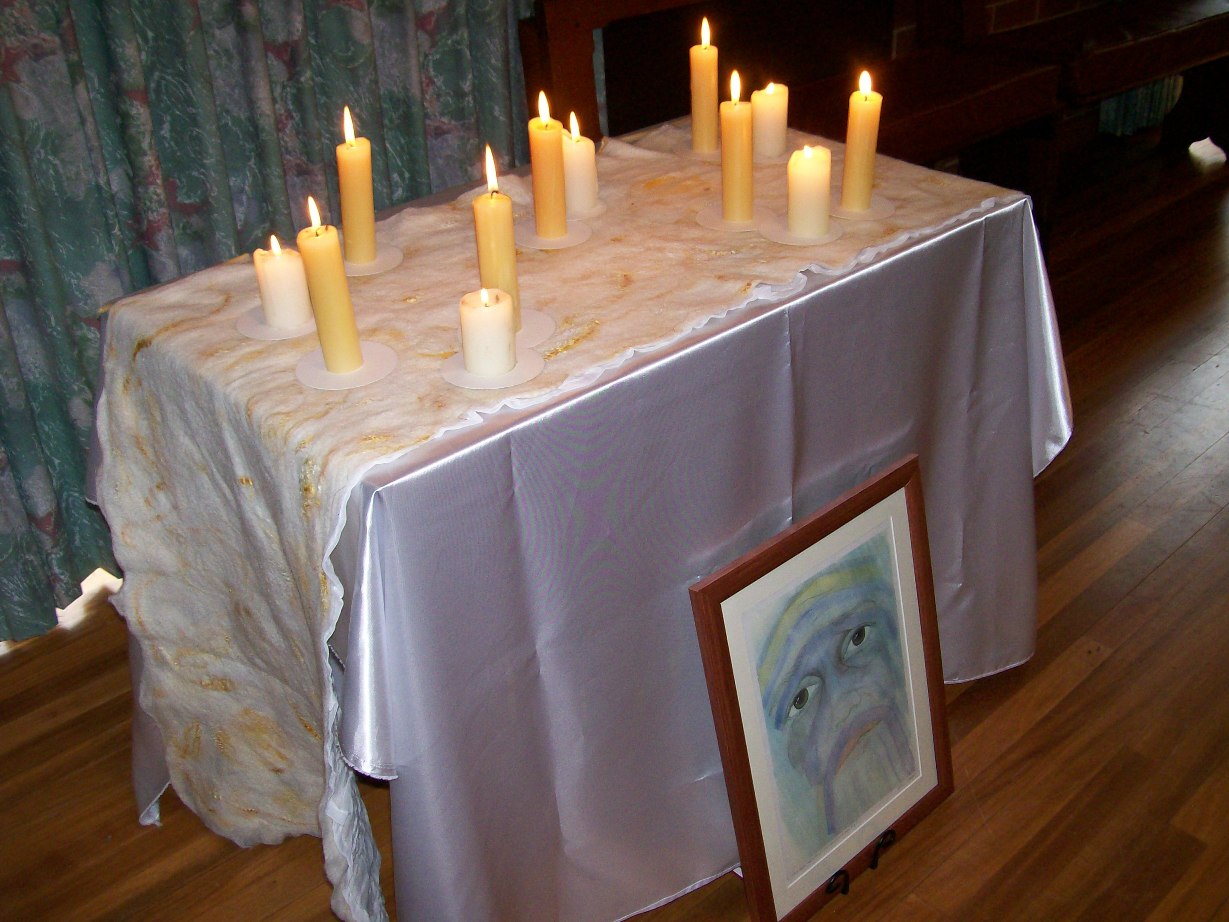
Focus on table, covered in white cloth, with many candles, and a print of Chris Neild's Man of Sorrows in front.

Two tapers are lit from
the Paschal candle, and as the Elder reads John 17:1-11 (with strategic pauses), each time the word 'glory/glorify' is read, two candles are lit, until all the candles on the table are alight at the end of the reading.

The people are invited to contemplate the question: "What is glory?" as they listen to the reading and gaze on the image and the candles.
A period of very profound silence ensued.


Station 5
- around the Paschal Candle- facing outwards towards the exit

Song - TIS 613 Lord of all hopefulness Lord of all joy
Christina and I pronounced a blessing

Benediction- A Christmas Blessing